
Welcome to Strong & Strategic After 50: My Story and Why I Built This
I want to start with honesty.
I didn't build this platform because I figured everything out and wanted to share my success story. I built it because I spent years feeling terrible and couldn't find anyone who could tell me why — or what to actually do about it.
This is that story. The unvarnished version.
The Years I Felt Like I Was Disappearing
For several years before I understood what was happening, I felt horrible.
Not "a little run down" horrible. Genuinely, persistently, can't-explain-it horrible.
I was managing a demanding career. My mother-in-law had come to live with us, which I did willingly and with love — but caregiving at that level takes everything you have. My joints ached in a way I couldn't account for. My brain felt like it was wrapped in cotton. I was exhausted in a way that sleep didn't touch. And I kept being told, in one form or another, that my labs looked fine.
What nobody told me — what I didn't know for years — was that I had Hashimoto's thyroiditis. An autoimmune condition that attacks the thyroid, drives systemic inflammation, causes joint pain, brain fog, fatigue, weight changes, and mood disruption. Sitting there untreated, quietly making everything harder.
It took a functional medicine doctor who was willing to run the right tests — not just the basic thyroid panel but the full picture — to finally find it. My body was severely inflamed. The inflammation explained so much. And for the first time in years I felt like someone was actually looking, not just glancing. She didn't just check whether my numbers fell inside the "normal" range and call it done. She asked how I felt. She treated me — not my lab results. That distinction sounds simple. It is not simple. It is actually everything.
That doctor changed my life. I am also here to tell you that I went through some genuinely terrible doctors on the way to finding her — and then again when life circumstances meant I had to find another one. Including a functional medicine practitioner who, despite charging a premium for a holistic approach, somehow managed to make me leave her office in tears on a regular basis. Finding the right provider is not always a straight line. But it is worth every detour. You deserve a doctor who treats how you feel as data — because it is.
I learned to advocate for myself loudly and specifically. I did a lot of research and learned to ask different questions. I learned to find providers who would partner with me rather than manage me. And I learned — slowly, imperfectly, over a lot of time — what my particular body needed.
The Hysterectomy That Changed Everything Overnight
Around age 50 I had a full hysterectomy.
If you've been through this you already know what I'm about to say. If you haven't — here is what they don't adequately prepare you for. A full hysterectomy doesn't ease you into postmenopause. It drops you there. Overnight. No gradual transition. No gentle adjustment period. One day you are in perimenopause, navigating the slow shift, and then suddenly you are fully, completely postmenopausal — and your body knows it immediately.
The hormonal crash was significant. And navigating what came next — which hormones, in what form, at what dose, adjusted how often — was its own education entirely. Estrogen, progesterone, testosterone. How they interact with thyroid medication. How getting one wrong affects all the others. How what works at one dose stops working as your body adjusts. And how frustratingly few doctors understand the specific needs of women in this situation — not just postmenopause in general, but postmenopause layered with autoimmune thyroid disease, with adrenal considerations, with the particular complexity that comes from a surgical rather than natural transition.
I learned to advocate loudly. I learned to research deeply. And I learned to walk away from providers who weren't willing to partner with me — no matter how inconvenient that was.
How I Found Movement I Actually Loved
Somewhere in the middle of all of this my husband's doctor mentioned VR fitness.
I want to be honest — my first reaction was skepticism. I was not someone who loved exercise. I had never been someone who loved exercise. Exercise for most of my life had felt like punishment for having a body that didn't cooperate, and the idea of strapping a headset to my face didn't immediately change that.
But I tried it. Supernatural first, then Fun Fit Land, then FitXR.
And something happened that had genuinely never happened to me before in my entire relationship with exercise. I forgot I was exercising. I was moving, sweating, getting my heart rate up — and it felt like playing. Not like a workout. Like something I actually wanted to do again tomorrow.
That was new. That mattered more than I can adequately explain.
VR fitness became my cardio. Not because it's the objectively superior method — but because it's the one I show up for. Consistently. Without dread. And consistency, I have learned, beats perfection every single time.
The Muscle Revelation — And the Mindset Shift That Made It Stick
The more I read — and I read a lot — the clearer one thing became.
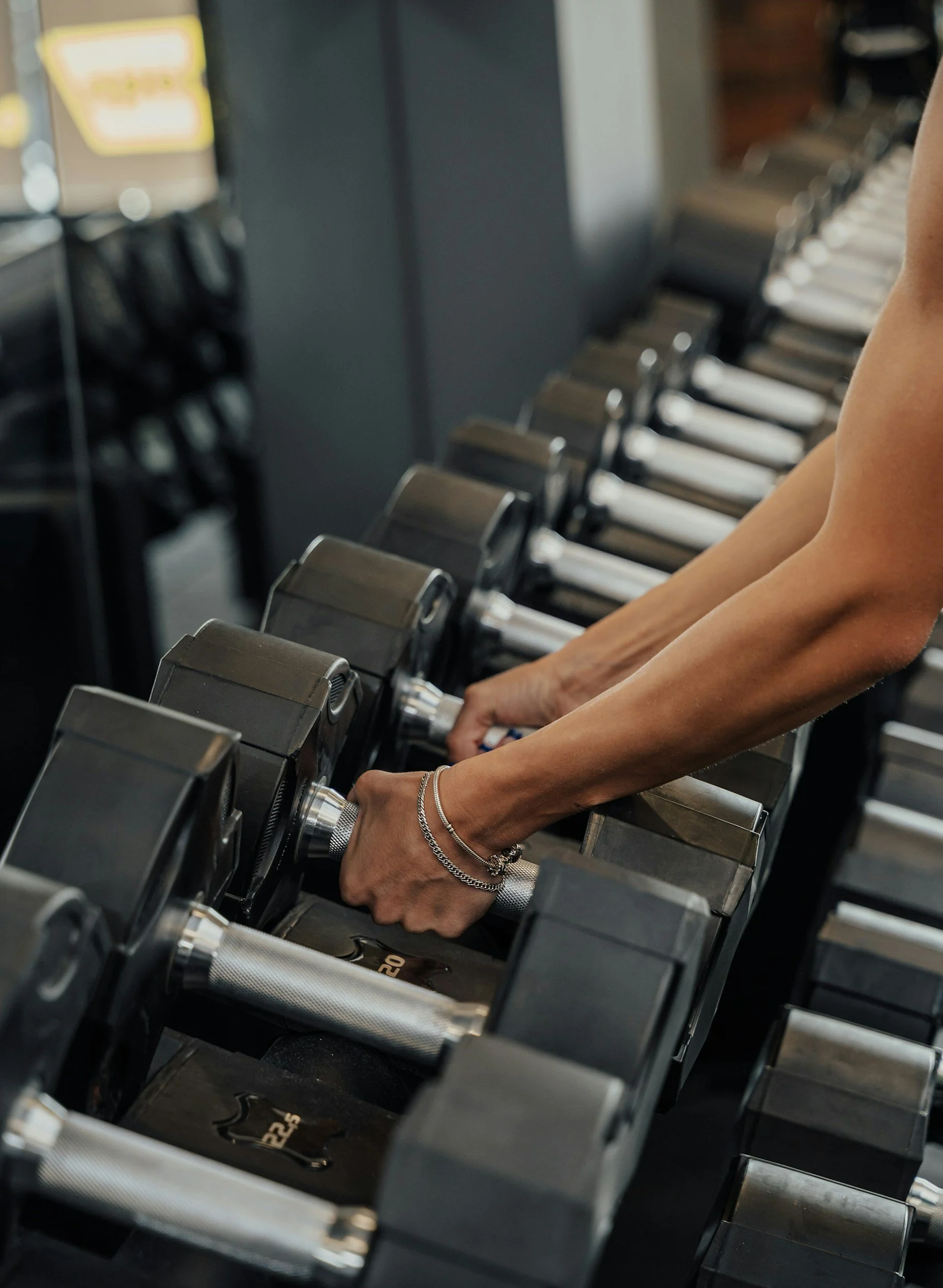
Cardio alone wasn't going to get me where I wanted to go. The research on muscle loss after menopause is sobering. Without deliberate effort to preserve and rebuild it, women lose muscle mass at an accelerating rate after estrogen declines. And muscle isn't just about how you look. It's your metabolism. It's your bone density. It's your ability to carry groceries and climb stairs and live independently and do all the things you used to do without thinking about them.
I needed to strength train. Properly. Progressively. I started using Tempo Fit.
But here's what I wasn't prepared for — the mindset shift that strength training demanded of me was as significant as the physical work itself.
I am a perfectionist by nature. For most of my life that meant that if I couldn't do something properly I wouldn't do it at all. Miss a workout? The whole week was a write-off. Can't do a full pushup? Then pushups weren't for me. That all-or-nothing thinking had quietly sabotaged my relationship with fitness for decades.
Strength training broke that pattern. Not immediately — but inevitably.
I started at a beginner level. A true beginner level. I could not perform a pushup on my knees. I modified everything. I went slowly. I felt humbled in ways I hadn't expected. And then something remarkable happened — I kept going anyway. I modified instead of quitting. I showed up imperfectly instead of not showing up at all. And the progress came faster than I ever imagined it would. The body, it turns out, responds quickly when you give it what it needs.
The mindset shift that came with all of this was profound. I stopped exercising to lose weight. I started exercising to feel better, move better, and be able to do the things I love for as long as possible. I stopped punishing my body and started investing in it. That reframe changed everything — not just about fitness but about how I approach this entire season of life.
What I'm Careful About That Most People Don't Talk About
Here's something I want to be transparent about because I don't see it discussed enough.
Doing all of this at 50-plus is different from doing it at 35. My adrenals are part of the equation in a way they weren't before. Overtraining, under-recovering, chronic stress — these things hit differently now and the consequences show up faster. I am careful about intensity. I am careful about recovery. I am careful about not pushing in ways that feel productive but are actually working against my hormonal balance.
This is one of the things that so many well-meaning fitness approaches get wrong for women our age. What works for a 30-year-old — even a 30-year-old woman — is not automatically what works for us. Our bodies are operating in a different hormonal context. The approach has to match the reality.
Finding providers who understand this has been as important as anything else on this journey. Doctors who understand that women in peri and postmenopause have specific needs that require specific knowledge — not just a slightly modified version of standard care.
Why I Built This
I started asking these questions because I was desperate for answers.
I tried things that didn't work. I followed advice that made me feel worse. I spent money on programs and practitioners who didn't understand my situation. I felt dismissed, confused, and alone in a way that I now know was completely unnecessary — because there are answers, there are solutions, and there are women going through exactly this who needed someone to just tell them the truth.
I'm not a doctor. I want to be absolutely clear about that. Nothing I share here is medical advice. But I am someone who has lived this — who has the Hashimoto's diagnosis, the hysterectomy, the hormone journey, the terrible doctors and the finally-right ones, the VR fitness breakthrough, the strength training revelation, the protein obsession, the inflammation management, the adrenal awareness — all of it.
And I built Strong & Strategic After 50 because I wished, desperately, that someone had built it for me.
If you are in the middle of this — if you are tired and foggy and frustrated and being told everything looks fine — I want you to know that you found the right place. You are not crazy. You are not weak. You are not done.
You just needed someone who has been where you are.
I'm her.
Ready to take your first step? Download the free Strong & Strategic After 50 Starter Guide — the resource I wish I'd had at the beginning of this journey.
With you in this, Strong & Strategic After 50